
Claim Settlement Ratio vs Incurred Claim Ratio in Health Insurance (2026 Guide) | PuneInvest
Last verified: 1 September 2026 — Definitions and IRDAI timelines checked against IRDAI Annual Report 2023-24 and IRDAI (Protection of Policyholders’ Interests) Regulations 2017. Ratios change yearly — check the latest IRDAI report before buying. Guide by Rajendra Todkar, PuneInvest.
You buy health insurance to get paid when you claim. Two ratios tell you if the insurer actually pays — but they measure opposite sides of the business, and you need both.
1. What Is Claim Settlement Ratio (CSR)?
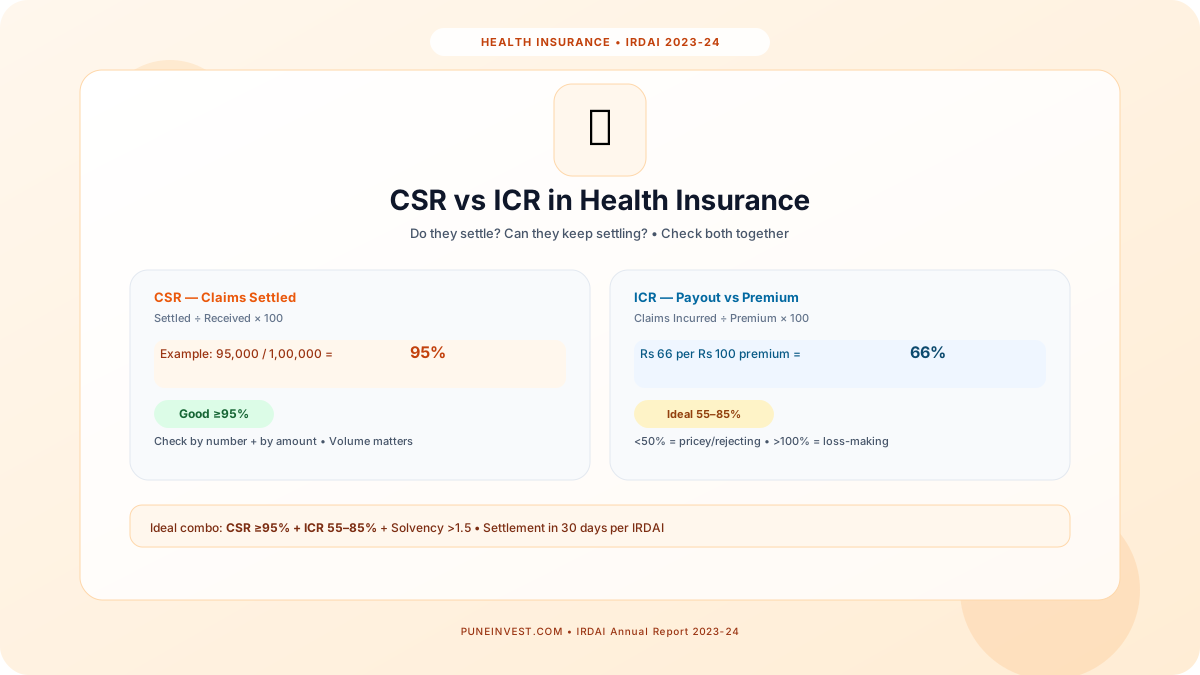
CSR = (Number of claims settled / Number of claims received) × 100
It counts heads, not rupees. If an insurer receives 100,000 claims in a year and settles 97,000, CSR = 97%.
- Published per FY in IRDAI Annual Report, also by number and by amount.
- Higher is generally better. For health insurance, look for CSR ≥ 95% by number and no sharp 2-year drop. A 99.9% that never moves while the denominator is tiny can be a red flag — check volume.
- Look at CSR by amount too — an insurer that settles many small claims but rejects big ones looks good by number but bad by amount.
2. What Is Incurred Claim Ratio (ICR)?
ICR = (Net claims incurred / Net premium earned) × 100
It measures rupees: for every Rs 100 of premium collected, how many rupees were paid as claims (plus change in outstanding reserves).
| ICR reading | What it signals |
|---|---|
| <50% | Collecting a lot, paying very little — possibly strict underwriting/rejections or overpriced product. Avoid if consistently low for 3 years. |
| 50–60% | Profitable, sustainable zone for most standalone health insurers. |
| 60–85% | Balanced — competitive pricing, paying fairly. Sweet spot for group health. |
| 85–100% | High payouts — could mean generous claims or underpricing. OK for 1 year, risky if sustained. |
| >100% | Loss-making — paid more than collected. New insurers can show this early, but 2+ years >100% signals future premium hikes or tighter claims. |
Do not chase the lowest ICR. A 40% ICR insurer is not “efficient” — it may be rejecting more than peers.
3. Why You Need Both — CSR + ICR Together
- High CSR (97%) + ICR 55–80% — Ideal: pays most claims and remains solvent.
- High CSR + ICR >100% — Pays now but may struggle later — watch solvency ratio (>1.5 required by IRDAI) and premium jumps.
- Low CSR (<90%) + Low ICR (<50%) — Double warning: rejecting claims and still not pricing fairly.
- CSR high + Amount-CSR much lower — Signals partial settlements (deductions). Ask for claim amount ratio.
4. IRDAI Snapshot: Standalone Health Insurers (2023-24 Annual Report, indicative)
For illustration — verify latest year before deciding:
| Insurer (Standalone Health) | CSR by number (2023-24) | ICR (Net incurred) |
|---|---|---|
| Star Health | ~99% | ~66% |
| Care Health | ~95% | ~62% |
| Niva Bupa | ~95% | ~58% |
| HDFC Ergo Health* | ~97% | ~68% |
| ICICI Lombard (general + health) | ~96% | ~78% |
*Figures are illustrative aggregates from IRDAI 2023-24 — insurers publish segment-wise splits. Use IRDAI Table 2.12 / 5.8 for exact.
5. Formula and Worked Example (CSR)
CSR = (Claims settled / Claims received) × 100
Example: Received 1,00,000 claims, settled 95,000, 3,000 rejected, 2,000 pending at year-end. CSR (IRDAI method, on available decisions) = 95,000 / 98,000 × 100 ≈ 96.9%. Some summaries simplify to 95,000 / 1,00,000 = 95%.
Always check footnotes — pending claims treatment differs.
6. What Is a Good Ratio to Target?
- CSR by number: ≥ 95% consistently for 3 years; by amount ≥ 85%.
- ICR: 55–85% stable for 3 years. For retail health, 60–75% is commonly seen in sustainable insurers.
- Solvency ratio >1.5 and complaint ratio (IRDAI) trending down — add to checklist.
- Claim settlement TAT: IRDAI mandates settlement within 30 days of last necessary document; interest at 2% above bank rate if delayed (Regulation 16, Protection of Policyholders’ Interests).
7. Checklist Before You Buy Health Insurance
- Pull latest IRDAI Annual Report — CSR (number & amount) and ICR for 3 years.
- Check insurer’s network hospital count and cashless TAT — ratios don’t capture service speed.
- Read claim amount ratio — why health insurance claims get rejected covers document gaps and waiting-period issues.
- Compare how to choose health insurance in India — CSR/ICR are two boxes, not the whole form.
Frequently Asked Questions
Is a higher CSR always better? Usually yes, but verify volume and amount-CSR. A 99% on 2,000 claims is less proven than 96% on 200,000 claims.
What ICR is ideal? For health, 55–85% stable. Below 50% for 2+ years suggests overcharging or tight claims; above 100% suggests underpricing.
Can IRDAI force payment? IRDAI gives 30 days to settle after final documents. Beyond that, penal interest applies. You can escalate to Insurance Ombudsman / Bima Bharosa.
Should I compare life insurance CSR for health? No — life and health claims behave differently. Use health-specific CSR/ICR only.
Where to find official data? irdai.gov.in > Annual Reports > Claims and Solvency sections and insurer’s public disclosures.
Conclusion: Don’t pick by CSR alone. Pair CSR (do they settle?) with ICR (can they keep settling without hiking premium?) and claim TAT. An insurer that does all three well is the one you can count on when you’re in a hospital bed.
Also read: Reasons why health claim gets rejected • Common health insurance terms • Claim settlement ratio is important in health insurance — deep dive