
Credit Card Balance Transfer in India (2026 Guide): Fees, Best Banks & How It Works | PuneInvest
Last verified: 1 September 2026 — Rates and fees below were checked on SBI Card, HDFC Bank, ICICI Bank and Axis Bank official credit-card pages and the RBI Master Direction on Credit Card and Debit Card Issuance. Offers change frequently — confirm with your bank before applying. This guide is written by Rajendra Todkar, Founder, PuneInvest, based on live verification and common client queries in Pune.
When you carry a large credit-card outstanding at 36–45% per year, a balance transfer can feel like a lifeline. It moves that high-interest debt to a different bank’s card at 0% or a low rate for a few months, so more of your payment cuts principal instead of interest.
Done with discipline, it is the cheapest way to kill credit-card debt. Done without a plan — paying only the minimum and swiping the new card again — it just adds a 1–3% fee to the same problem.
This 2026 guide covers how balance transfer works in India, the real fees with GST, which banks offer what, and when a personal loan is actually better.
What Is a Credit Card Balance Transfer?
A credit card balance transfer moves outstanding dues from one bank’s card (Bank A) to another bank’s card (Bank B) that offers a promotional rate.
Example: You owe Rs 80,000 on an HDFC card at 42% p.a. You get an SBI Card with a 0% balance-transfer offer for 60 days. SBI pays Rs 80,000 to HDFC directly. You now owe Rs 80,000 (+ transfer fee) to SBI at 0% for 60 days instead of 42% to HDFC.
Key rules in India:
- Transfer is only between different banks — you cannot transfer within the same bank.
- You can usually transfer up to 75–80% of the new card’s credit limit, not the full limit.
- Most offers are 0% for 60–180 days (2–6 months), or a low EMI rate of 9–14% p.a. for 6–12 months. No bank offers 0% for 18–21 months like in the US.
- If any balance remains when the promo ends, it reverts to the card’s regular finance charge of 30–42% p.a. (around 3.5% per month) immediately.
The three numbers that matter:
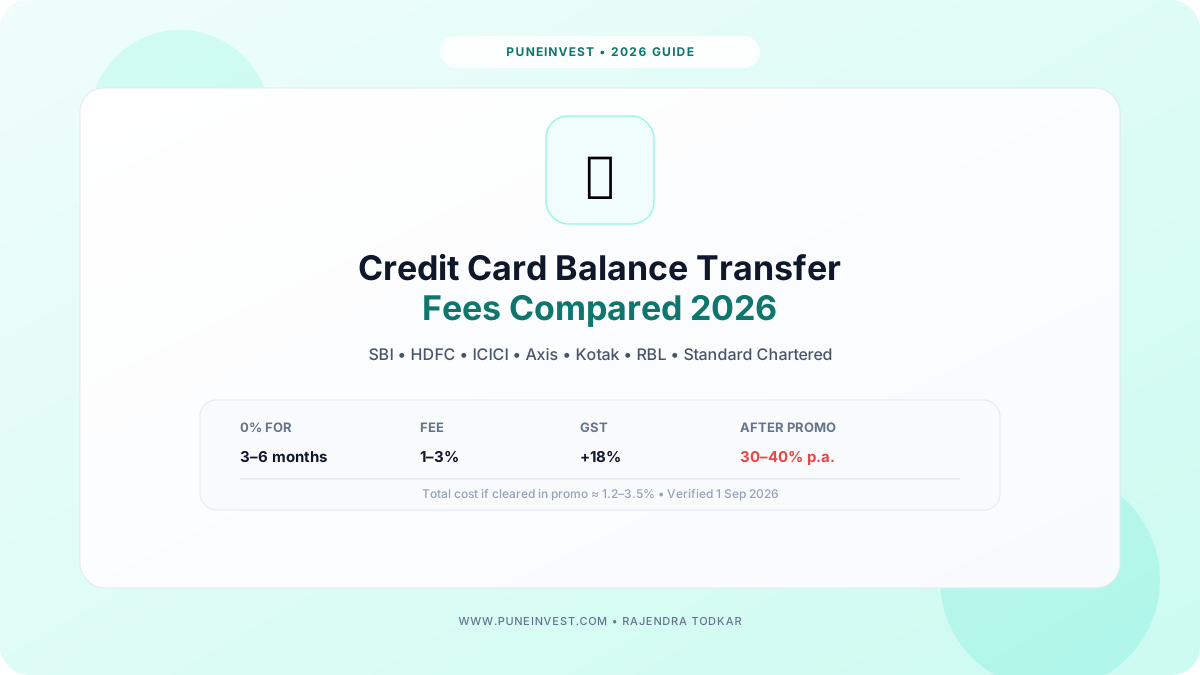
0% for 3–6 months(use it aggressively) |1–3% transfer fee + 18% GST(the real upfront cost) |30–40% p.a. after promo(the trap).
How a Credit Card Balance Transfer Works in India — 7 Steps
| Step | What to do | Watch out |
|---|---|---|
| 1 | Add up total outstanding across all cards you want to consolidate | Don’t undercount - include all cards |
| 2 | Check CIBIL score (700+ preferred) and whether you are pre-approved in your bank’s app under Benefits / Balance Transfer / EMI Offers | New application = hard inquiry, -3 to -10 points for 3–6 months |
| 3 | Compare offers: 0% for how many days, transfer fee, GST, annual fee | A “0%” with 3% fee is costlier than 0.99%/mo with no fee for larger amounts |
| 4 | Apply for the balance-transfer card or request BT on an existing card | Approval depends on repayment history (usually 6+ months good record needed) |
| 5 | Initiate transfer: give Bank B the old card number, bank name and amount to transfer; Bank B pays Bank A via NEFT/cheque/DD | Confirm old card shows zero dues — bank transfer can take 5–10 days |
| 6 | Freeze the new card — do NOT use it for fresh purchases | On most BT cards, new purchases attract interest from day 1 even during 0% on transferred balance |
| 7 | Pay Total transferred amount ÷ promo months every month, not just the minimum | Minimum-only = large unpaid balance that jumps to 30–40% when promo ends |
The issuer of the new card contacts your old issuer to confirm. Once confirmed, the balance appears on the new card account. You must still make at least the minimum payment each month during the promo — missing it can cancel the promo rate.
Fees and Hidden Costs in India (2026)
Balance transfer is never truly free, even when advertised as 0%.
- Balance transfer / processing fee: 1–3% of amount transferred, charged upfront and added to the new balance.
- GST at 18% on that fee. So a 2% fee is effectively 2.36%.
- Annual / joining fee of the new card, if any.
- Reversion rate: unpaid balance after promo = 30–40% p.a.
- Minimum-payment trap: miss the minimum and the promo may be revoked.
Effective cost if you clear in full during promo: 1.18% to 3.54% one-time for the entire promo period — far cheaper than 36–45% annual interest on the old card.
Per-Bank Snapshot (Indicative, confirm at application)
| Bank | Tenure / Offer | Interest on BT | Processing Fee + GST |
|---|---|---|---|
| SBI Card | 60 days at 0% or up to 180 days EMI | 0% for 60 days, then from ~9% p.a. (about 1.7% per month on 6-month plan) | Nil on select plans, else ~1.5% or Rs 199 whichever higher (+ GST). Up to 75% of limit. |
| HDFC Bank | Balance Transfer on EMI, 9–48 months | 0% for 3 months on select cards, else 12–18% p.a. annualised | ~1% of BT amount, min Rs 250 (+ GST). No documentation for existing HDFC cardholders. |
| ICICI Bank | Up to ~Rs 3 lakh, 3 or 6 month EMI | 0% for 3–6 months on eligible cards, else shared at application | Shared at application (+ GST). |
| Axis Bank | MyZone, Magnus and others | From ~12% p.a. | ~1.5% of BT amount, min Rs 250 (+ GST). |
| Kotak Mahindra Bank | 3 or 6 months | 0% option for 3 months | ~Rs 349 per Rs 10,000 transferred (+ GST). |
| RBL Bank | 3 / 6 / 12 month options | 0% for 3 months on select, else from 11.73% p.a. | ~2.99% min Rs 750 for 3-month; ~Rs 499 for 6 & 12 month (+ GST). |
| Standard Chartered | Up to Rs 5 lakh, 3–24 months | ~0.99% per month for first 6 months, then card rate | As applicable at transfer (+ GST). |
Source checks on 1 Sep 2026: SBI Card Balance Transfer, HDFC Bank Credit Cards and RBI Master Direction. Individual eligibility, limit and final rate are decided by the bank at application.
True Cost Comparison: Rs 1 Lakh Example
This is our own analysis using the rates above — not copied from aggregators.
| Scenario | What you pay upfront | What you pay overall | End state |
|---|---|---|---|
| Stay on 40% card, pay 3% minimum (Rs 3,000 on Rs 1L) | Rs 0 | Rs 40,000+ interest per year; principal barely moves | Debt grows, CIBIL worsens |
| Balance transfer 0% for 6 months, 2% fee and you pay Rs 17,000 per month (Rs 1,02,000 / 6) | Rs 2,000 fee + Rs 360 GST = Rs 2,360 | Rs 2,360 total cost if cleared in 6 months | Debt-free in 6 months |
| Personal loan 14% for 3 years for same Rs 1L | Processing ~1% | EMI ~Rs 3,417, total interest ~Rs 23,000 | Debt-free in 36 months with fixed EMI |
Takeaway: Balance transfer (Rs ~2,360) beats a personal loan (Rs ~23,000) massively only if you can pay ~Rs 17,000 per month and clear before promo ends. If you can only afford Rs 3,400 per month, the personal loan’s fixed schedule is safer than facing 36–40% after 6 months.
Pros and Cons
| Pros | Cons |
|---|---|
| Save high interest — 0% lets 100% of payment cut principal | Processing fee 1–3% + GST added immediately |
| Pay faster and simplify multiple cards into one payment | Temptation to swipe new card and add fresh debt |
| Can improve CIBIL if utilization drops and payments are on time | Missed payment can void promo and hurt CIBIL |
| Short interest-free window to breathe and plan | Not everyone gets approved — needs CIBIL ~700+ and good history |
| Cheaper than revolving at 36–45% if cleared in promo period | Remaining balance after promo jumps to 30–40% p.a. |
See also our detailed explainer on how balance transfers affect your CIBIL score and the broader guide to boosting your credit score.
Who Should Apply — and Who Should Not
Balance transfer is a good fit if:
- You carry high-interest debt (36–45% p.a.) and can realistically clear it in 3–12 months with disciplined payments.
- You have a CIBIL score of 700+ and 6+ months of clean repayment on existing cards.
- You have not applied for a home loan or major credit in the next 3–6 months (new hard inquiry effect).
- The total fee + GST is less than 2–3 months of interest you would otherwise pay.
Take a personal loan instead if:
- You need 12–36 months to repay (e.g., Rs 3–5 lakh outstanding).
- You want one fixed EMI and a clear end date instead of a short promo cliff.
- You may not qualify for a new card due to CIBIL.
If you are unsure whether credit cards are good or bad for your habit, clear that first — a BT does not fix overspending.
How to Apply for a Balance Transfer
You do not need a branch visit:
- Check the app: HDFC, ICICI, SBI and Axis show BT offers under Benefits / Balance Transfer / EMI & Offers (labels change with updates). Check if you are pre-approved.
- Via customer care / SMS / NetBanking: Call the number on the back of the card or send the keyword given on the bank’s BT page (e.g.,
BTto the bank’s service number). - Provide details: Old card number, bank name, amount to transfer, consent to fees and interest.
- Confirmation and payout: New bank pays old bank via NEFT/cheque/DD. Keep paying at least the minimum on the old card until its statement shows zero.
Processing is usually 5–7 days to an existing card, up to 3–4 weeks if you applied for a new card plus BT.
CIBIL Score Impact
This is why we link this post closely with how balance transfers affect your credit score:
- Hard inquiry: applying creates a hard inquiry — typically -3 to -10 points, fading in 3–6 months. Avoid applying if a home loan is due soon.
- Credit utilization (30% of score): Old card utilization falling from 80–90% to 0–10% helps; but a new card with a small limit that is 75% filled hurts. Try to keep overall utilization below 30%.
- Payment history (35% of score): On-time payments during promo lift score; a single 30-day late can drop it 60–110 points.
- Average age of accounts (15% of score): New card lowers average age slightly — a minor, temporary effect that reverses as the account ages.
12–18 months of on-time, low-utilization history after a successful BT often lifts score by 50–80 points. Closing the old card right after transfer hurts — keep it open at zero balance to preserve age and limit.
Balance Transfer vs Personal Loan — Decision Matrix
| Can you clear full amount in the 0% window? | Best option |
|---|---|
| Yes — 3 to 6 months (e.g., Rs 1L with Rs 17k–33k per month) | Balance transfer — total cost ~Rs 2k–3k, debt-free quickly |
| No — needs 12–36 months (e.g., Rs 3L with Rs 8k–10k per month) | Personal loan at 12–15% — fixed EMI ~Rs 10,250 for Rs 3L / 3 years, total interest ~Rs 69k but predictable |
| Borderline or CIBIL uncertain | Partial BT for the amount you can clear in promo + personal loan for the rest; compare total fees + interest |
Worked decision: Rs 3 lakh at 40%. BT 0% for 6 months needs Rs 50,000 per month plus ~Rs 3,000 fee. Personal loan 14% for 3 years needs Rs 10,250 per month. If you can pay Rs 50k, BT saves ~Rs 66k. If you can only pay Rs 10k, the loan is the safer path.
5-Step Strategy to Become Debt-Free with a Balance Transfer
Balance transfer alone does not remove debt — it buys you cheaper time. Use it this way:
- Transfer, then freeze. Do not swipe the BT card for new purchases — most banks charge 2.5%–3.5% per month on new spends even while transferred balance is at 0%.
- Calculate your must-pay:
Transferred amount + fee + GST÷promo months. Example: Rs 1,02,360 ÷ 6 = Rs 17,060 per month. That is your real minimum. - Automate it. Set an auto-pay for that amount 3–5 days before due date.
- Check old card at zero. Keep it open, but cut usage. One auto-debit of a small utility bill paid in full keeps it active and helps CIBIL.
- Have a Plan B for month 6. If balance remains, apply for a fresh BT before the promo ends (if CIBIL allows) or take a personal loan immediately — do not let it revert to 40%.
After you are debt-free, redirect the same monthly amount into an equity SIP and build a 6-month emergency fund — the same habit, now building wealth instead of paying interest.
Three Common Mistakes to Avoid
- Making only the minimum due during 0% — you will have ~70% left when the promo ends.
- Using the BT card for EMIs or wallets thinking they are interest-free — they are not.
- Applying for two BT cards at once — two hard inquiries + two new accounts hurt CIBIL plus approval odds.
Frequently Asked Questions
What is the fastest way to clear credit-card debt in India?
If you can pay aggressively, 0% balance transfer cleared before promo ends is cheapest (1–3% one-time). If you need longer, a personal loan at 12–15% with a fixed tenure is more predictable than revolving at 36–45%.
How much does a balance transfer cost?
Typically 1–3% of transferred amount plus 18% GST. On Rs 50,000, that is Rs 500–1,500 plus GST. Annual fee of the new card, if any, is extra.
Which banks offer the best balance transfer in India in 2026?
SBI Card (0% for 60 days, then EMI), HDFC Bank (BT on EMI, 9–48 months), ICICI, Axis, Kotak and RBL all offer BT — offers vary by card and CIBIL. Always compare the 0% days, fee and post-promo rate on the bank’s own page before choosing.
What CIBIL score is needed for a balance transfer?
Banks generally prefer 700+. Below that, approval is possible but the rate or fee may be no better than your existing card. Check your score first to avoid unnecessary hard inquiries. Learn more in our CIBIL and balance transfer explainer.
How long does balance transfer take?
5–7 days if transferred to an existing card; up to 3–4 weeks if you also applied for a new card.
Can I transfer within the same bank?
No. Transfer is allowed only between cards of different banks.
What happens if I don’t pay before the promo ends?
Unpaid balance starts accruing the card’s regular finance charge (often 30–42% p.a.) from the next statement. The saving from the 0% window is lost quickly.
Is a 0% balance transfer really interest-free?
During the stated days (often 60–90 days), yes — no interest on the transferred amount if you pay the minimum on time and make no new purchases. The fee + GST still applies, and interest on any remaining balance after the window is very high.
Can balance transfer improve my CIBIL score?
Yes, indirectly. Paying off the old high-utilization card and making on-time payments on the new one helps utilization and payment history, which together are ~65% of the score. Short term there is a small dip from the inquiry. See our guide to boosting your credit score for the full playbook.
Conclusion
A credit card balance transfer is a tool, not a reward. Use the 0% window to pay hard each month, freeze fresh spending, and have an exit plan before the promo ends. If your debt needs more than a year, skip the BT and fix a personal loan — paying 14% for three years beats paying 0% for three months and then 40% thereafter.
If you want help choosing between BT and a loan for your exact dues and repayment capacity, contact us or explore our fin-cal calculators to model EMI and interest.
Disclaimer: Information verified on 1 September 2026. Banks revise fees, tenure and eligibility without notice. Confirm the latest Most Important Terms and Conditions (MITC) and fee schedule on the issuer’s website before applying. PuneInvest is a mutual fund distributor — this is education, not credit advice.