
How to Invest in Silver in India (2026): ETFs, Gold-Silver Ratio & Tax
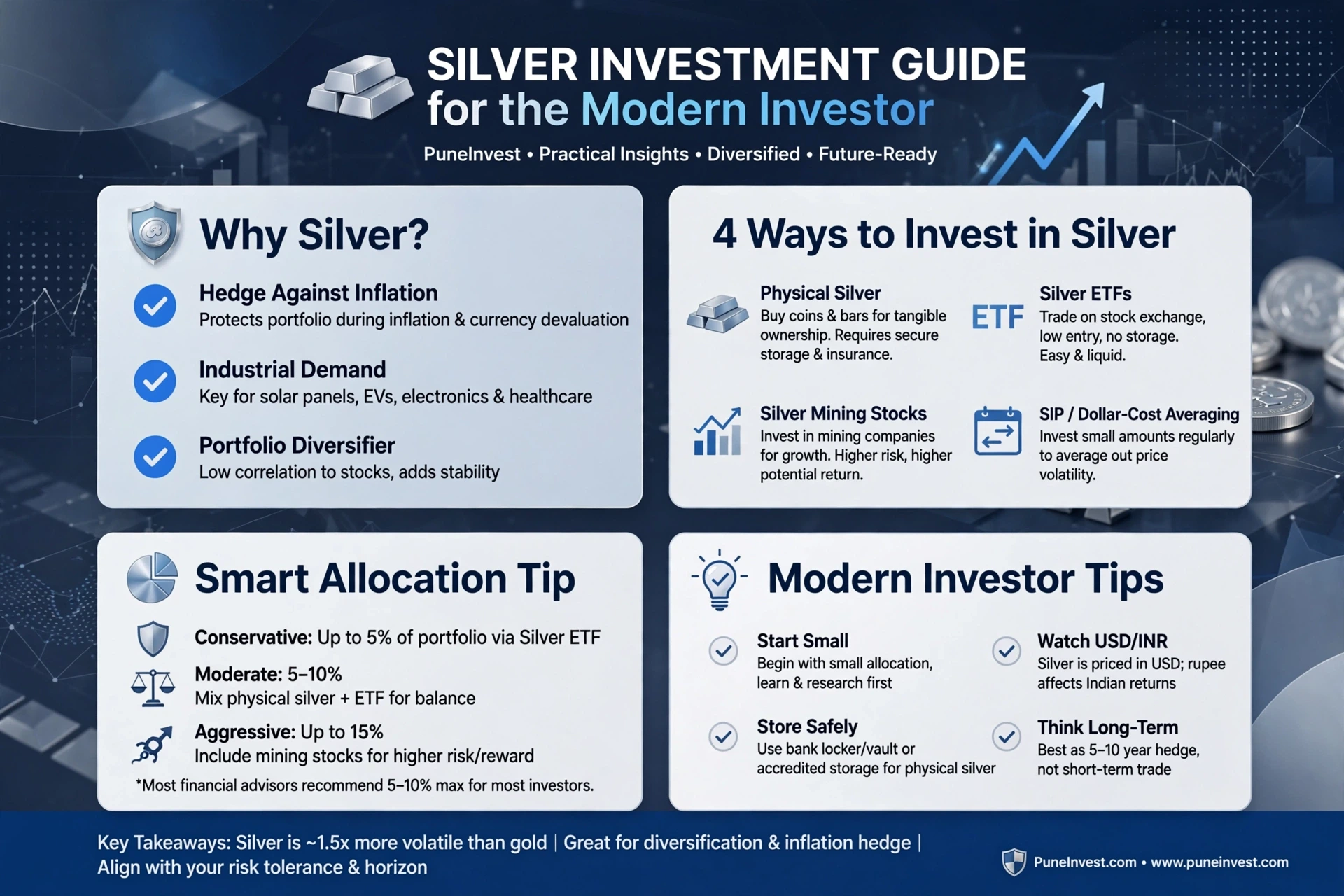
Every January, when I sit down with clients to plan their investments, silver comes up more often than almost any other asset. Partly because of the traditional affinity for buying silver during Diwali and weddings, and partly because silver has quietly become a very different animal than the one our grandparents knew. It still behaves like money in a crisis, but half of its annual demand now comes from factories — solar panels, smartphones, EVs.
That split personality is exactly what makes silver interesting, and also what makes it risky. Here is how I explain it to clients, and how you can think through it yourself.
Why Silver? It Plays Two Roles at Once
Most commodities do one job. Crude oil powers engines, copper carries electricity. Silver does two jobs at once, and its price is pulled by both.
The Safe-Haven Side
Think of silver as financial insurance. When confidence in the economy or in paper currency drops, money flows into precious metals — gold first, silver following. This demand supports silver’s price during tough times, which is why a small allocation can help balance risk in an otherwise equity-heavy portfolio.
The Industrial Side
This is where silver genuinely stands apart from gold. Roughly half of all annual silver demand comes from industry, and unlike gold, most of that metal is consumed and gone — it does not come back to the market. Some key uses:
- Solar panels — silver paste is essential in photovoltaic cells; solar is now the single largest industrial use of silver.
- Electronics — silver is the world’s best electrical conductor, so every circuit board, smartphone, and sensor contains some.
- EVs and green tech — electric vehicles use more silver than petrol cars, and demand rises with charging infrastructure.
- 5G and telecom — RF antennas and semiconductor packaging rely on silver’s conductivity.
- Medicine and water purification — silver’s natural antimicrobial properties are used in wound dressings, coatings, and filters.
The practical consequence: when the economy booms, industry soaks up supply. When it stutters, investment demand tends to provide a floor. That cushion is what separates silver from purely cyclical commodities.
The Gold-Silver Ratio: Is Silver Cheap or Expensive?
The gold-silver ratio tells you how many ounces of silver buy one ounce of gold. It is the quickest way to judge whether silver looks relatively cheap or rich next to gold.
Worked example in US dollar terms:
- Gold price = $4,800 per ounce
- Silver price = $80 per ounce
- Ratio = 4,800 ÷ 80 = 60:1, i.e. it takes 60 ounces of silver to buy 1 ounce of gold
How to read the number:
- High ratio (say 85+): silver is historically cheap relative to gold. Ratio traders treat this as a signal to rotate from gold into silver.
- Low ratio (below 60): silver has run ahead of gold, and mean-reversion risk is higher.
- Long-run average: roughly 60–70 over the past several decades.
One honest caveat from experience: a high ratio can stay high for years. The ratio is a compass, not a stopwatch — never buy silver on the ratio alone.
Why There Is a Structural Supply-Demand Deficit
For several consecutive years now, the global silver market has consumed more metal than mines have produced, plugging the gap by drawing down above-ground stockpiles (the Silver Institute’s World Silver Survey documents this annually). Two forces drive it:
- Mine supply is stuck. Most silver is a by-product of lead, zinc, and copper mining, so output barely responds when silver prices rise — miners cannot simply “produce more silver.”
- Industrial demand keeps climbing. Solar alone has added tens of millions of ounces of new demand every year, and recycling recovers only a fraction of what industry consumes.
A persistent deficit does not guarantee rising prices — available stockpiles can absorb a lot — but it tilts the medium-term balance in favour of the metal rather than against it.
How Can You Invest in Silver in India?
Gone are the days of needing a vault under the bed. Four practical routes exist today:
Physical silver (coins, bars, jewellery): emotionally satisfying and culturally familiar, but you carry making charges, purity risk (always insist on BIS-hallmarked silver), storage worries, and 3% GST at purchase. Resale spreads are wide.
Silver ETFs: the route I recommend for most investors. Each unit represents physical silver stored in a vault, and the ETF trades on the NSE/BSE like a share. You need a demat account. Examples: Tata Silver ETF, Aditya Birla Sun Life Silver ETF, ICICI Prudential Silver ETF, among many listed below.
Silver Fund of Funds (FoF): a mutual fund that invests in silver ETFs, bought directly from the AMC without a demat account. Slightly higher expense ratio, but the simplest entry point for small monthly SIPs.
Digital silver: platforms like MMTC-PAMP sell fractional grams backed by physical metal, convertible to doorstep delivery. Convenient, but watch the platform spread — buying and selling prices differ meaningfully from spot rates.
Tax on Silver Investments in India (Post-Budget 2024 Rules)
This is where most articles go silent, yet it decides your real return. Broad strokes for resident individuals:
- Silver ETFs and FoFs: units held for more than 12 months qualify as long-term. Gains are taxed at 12.5% flat, without indexation. Shorter holdings are taxed at your income slab rate.
- Physical silver: long-term only after 24 months, then also at 12.5% without indexation; below that, slab rate applies. GST paid at purchase is not recoverable.
- Always confirm the current treatment before filing — these rules were rewritten by the Finance (No. 2) Act, 2024, and the Income Tax Department’s website carries the operative text.
For most salaried investors, holding silver through an ETF or FoF inside a goal-based plan keeps tax reporting painless compared to physical metal.
Should You Invest in Silver Now?
Silver is not a “set and forget” core holding. It is a strategic satellite asset — volatile enough that it will test your patience in some years and reward it handsomely in others.
Consider it if you want a hedge against inflation and currency weakness, believe in the long electrification story, and can stomach drawdowns of 20–30% without flinching. For most portfolios I suggest keeping silver to a modest slice of overall precious-metals exposure — 5–10% of that sleeve, not of the whole portfolio — built gradually through an ETF or FoF rather than in one lump sum.
What’s Working in Silver’s Favour
Three macro tailwinds currently support the metal:
- Persistent inflation and currency devaluation, which historically push investors toward hard assets.
- The global green energy push, since every solar farm and EV factory is incremental industrial demand.
- Geopolitical uncertainty, which keeps safe-haven flows rotating into precious metals.
None of these guarantees a rising price — silver remains a moody asset — but together they form a stronger backdrop than silver has had in decades.
List of Silver ETFs in India
The table below covers currently running silver ETF schemes with their scheme codes and ISINs. Note that NAVs differ across schemes simply because each fund launched at a different time and base value — never compare absolute NAVs between funds. Figures change daily; verify the latest NAV on AMFI’s NAV tracker before acting.
| Scheme Name | Scheme Code | ISIN |
|---|---|---|
| 360 ONE Silver ETF | 153415 | INF579M01BC3 |
| Aditya Birla Sun Life Silver ETF | 149779 | INF209KB19F6 |
| Axis Silver ETF | 150610 | INF846K011K1 |
| Bandhan Silver ETF | 153929 | INF194KB1KI9 |
| DSP Silver ETF | 150523 | INF740KA1RE3 |
| Edelweiss Silver ETF | 152212 | INF754K01SF3 |
| Groww Silver ETF | 153524 | INF666M01LA1 |
| HDFC Silver ETF - Growth Option | 150556 | INF179KC1DI2 |
| ICICI Prudential Silver ETF | 149464 | INF109KC1Y56 |
| Kotak Silver ETF | 150948 | INF174KA1KU9 |
| Mirae Asset Silver ETF | 151779 | INF769K01KG6 |
| Motilal Oswal Silver ETF | 153820 | INF247L01FZ1 |
| Nippon India Silver ETF | 149758 | INF204KC1402 |
| SBI Silver ETF | 152725 | INF200KB1217 |
| Tata Silver Exchange Traded Fund | 152285 | INF277KA1984 |
| UTI Silver Exchange Traded Fund | 151730 | INF789F1AYK6 |
| Zerodha Silver ETF | 153413 | INF0R8F01091 |
Frequently Asked Questions
Is silver a better investment than gold? Not better — complementary. Gold stabilises a portfolio; silver adds growth torque with more volatility. Many investors hold both and shift weight between them based on the gold-silver ratio.
Do I need a demat account to buy a silver ETF? Yes, since ETFs trade on the stock exchange. Without a demat account, choose a Silver Fund of Funds from any AMC instead.
What is the minimum amount needed to start? An FoF SIP can start at ₹500–1,000 per month. An ETF requires buying at least one unit whose price tracks silver rates, plus brokerage.
Is digital silver safe? The metal behind reputable platforms is genuine and audited, but costs are higher than ETFs and you depend on the platform staying solvent and honest. For amounts beyond small experiments, prefer ETFs or FoFs.
How is silver taxed if I sell after two years? Through an ETF/FoF: long-term gains at 12.5% flat. Physical silver held beyond 24 months: also 12.5% without indexation. Gains within those periods are taxed at your slab rate.
Final Word
Silver is the metal of contradictions — ancient yet futuristic, a safe haven that also lives inside every solar panel. Understand both sides before buying, size the position humbly, and let it play the supporting role it does best.
Also read: